
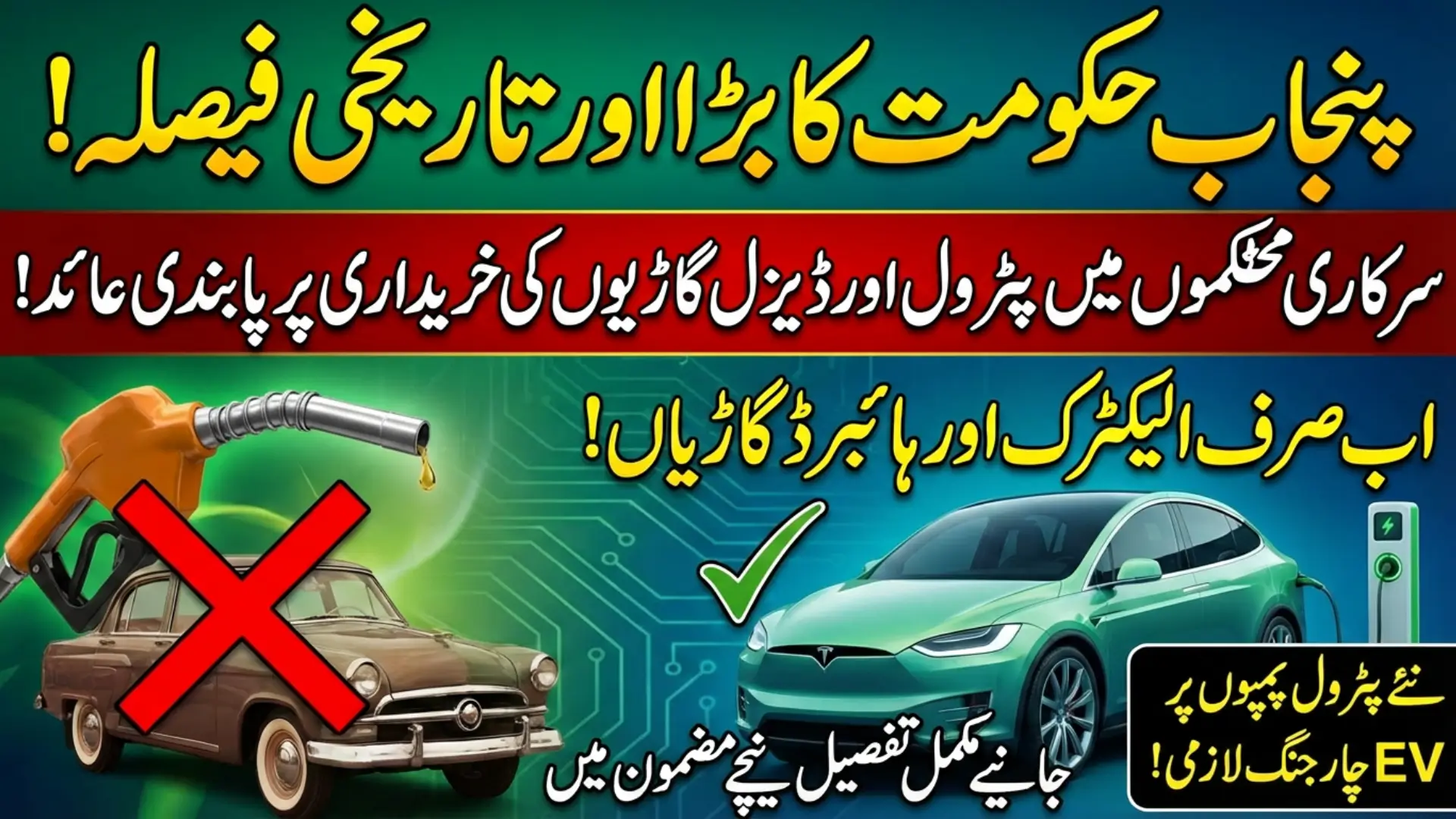
Punjab Bans Petrol And Diesel Vehicle Purchases For Government Departments
Punjab Bans Petrol And Diesel Vehicle Purchases For Government Departments: The Punjab government has taken a major policy decision to ban the purchase of new petrol and diesel vehicles for government departments, marking a significant shift toward cleaner and environment-friendly transport. This move reflects the province’s growing focus on reducing carbon emissions, lowering fuel dependency, and promoting sustainable energy solutions across public sector operations.
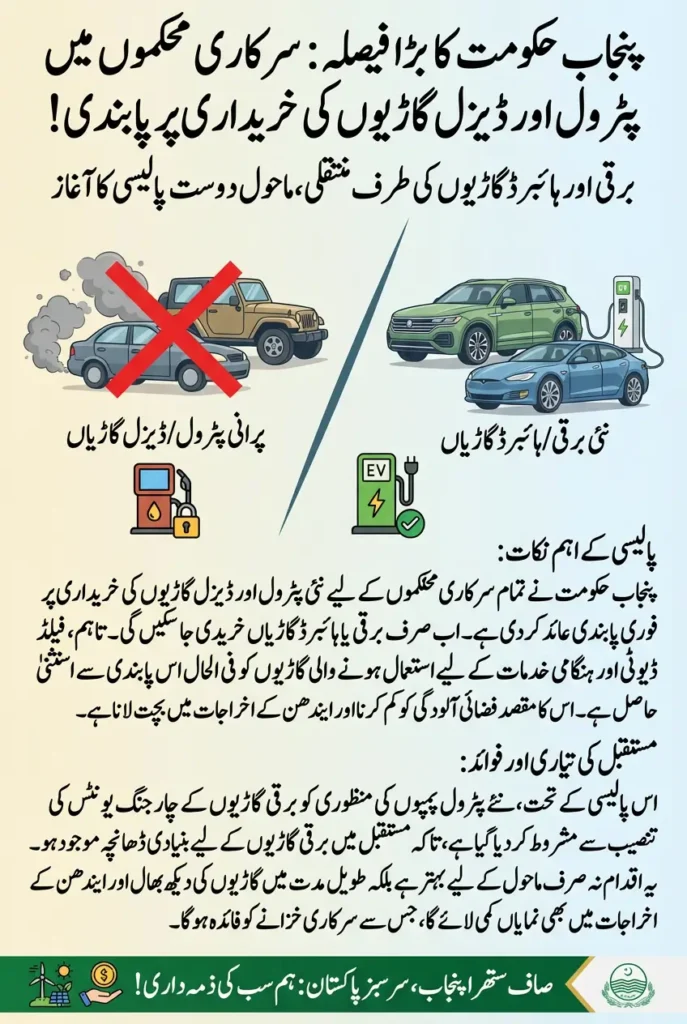
Under this new policy, government departments will now be allowed to purchase only electric or hybrid vehicles, while certain exemptions have been provided for field-duty vehicles. In addition, the government has linked the approval of new petrol pumps to the mandatory installation of electric vehicle charging units, ensuring future readiness for electric mobility. This article explains the policy in detail, its objectives, implementation strategy, impact on departments and citizens, and what it means for Punjab’s transport and energy future.
Also Read: REVOO Launches Lithium Electric Bikes A11 LFP & A12 LFP in Pakistan – Fast Charging, Long Range EVs
Background of the New Government Vehicle Policy
The Punjab government has been working on multiple initiatives to address rising environmental concerns, fuel costs, and urban pollution. Transport emissions have remained one of the major contributors to air pollution in large cities such as Lahore, Faisalabad, and Rawalpindi. The new vehicle policy aims to directly address this issue by reforming how government departments procure and use vehicles.
This decision was taken at a high-level administrative review, where environmental protection and energy efficiency were identified as long-term priorities. The Chief Secretary Punjab emphasized that the public sector must lead by example when it comes to adopting green solutions. By restricting petrol and diesel vehicles, the government intends to set a clear direction for cleaner mobility across the province.
Punjab Government Green Vehicle Policy 2026
Only electric and hybrid vehicles allowed for government departments
Eligibility
All Punjab government departments for official vehicle purchases
Financial Impact
Reduced fuel and maintenance costs through EVs and hybrids
Approval Method
Vehicle and petrol pump approvals via digital e-Biz Portal
Target Audience
Government departments and public sector operations
Usage Policy
EVs and hybrids for official use; field vehicles exempted
Verification & Compliance
NOCs linked with EV charging installation and policy checks
Quick Actions / Key Points
- Government departments can purchase only electric or hybrid vehicles
- Field-duty and emergency vehicles are currently exempted
- New petrol pumps must install EV charging units for approval
- Policy aligned with upcoming Punjab Electric Vehicle framework
Key Decision: Ban on Petrol and Diesel Vehicle Purchases
The central element of the new policy is the complete ban on purchasing new petrol and diesel vehicles for government departments. This applies to routine departmental vehicles used for administrative and official purposes.
- Government departments are no longer allowed to buy new petrol or diesel vehicles
- Only electric vehicles and hybrid vehicles are permitted for new purchases
- The ban applies to administrative and official-use vehicles
- Existing petrol and diesel vehicles can continue operating until replacement
This decision ensures a gradual transition rather than a sudden disruption. The government has clarified that departments will shift to cleaner options as part of regular vehicle replacement cycles.
Also Read: Pakistan Govt to Launch Newly Designed Currency Note Of Rs. 100, 500, 1,000 & 5000 In 2026
Exemptions for Field Duty Vehicles
While the policy is strict, the Punjab government has introduced practical exemptions to ensure that essential services are not disrupted. Vehicles used for field duties, emergency operations, and remote area work have been excluded from the immediate ban.
These exemptions recognize the current limitations of electric infrastructure in rural and remote regions. Departments such as health, rescue, law enforcement, and inspection services often require long-distance travel and rapid response, which may not yet be fully supported by electric vehicles.
- Field-duty vehicles are exempt from the purchase ban
- Emergency and operational vehicles can still be petrol or diesel-based
- Exemptions will be reviewed as EV infrastructure expands
- Departments must justify field-use requirements
This balanced approach allows the policy to remain realistic while still pushing toward long-term environmental goals.
Shift Toward Electric and Hybrid Vehicles
The policy strongly encourages the adoption of electric and hybrid vehicles for government use. Electric vehicles produce zero tailpipe emissions, while hybrid vehicles significantly reduce fuel consumption compared to traditional engines.
The Punjab government believes that this transition will reduce fuel expenses, maintenance costs, and overall environmental impact over time. Hybrid vehicles are seen as a transitional solution, especially for departments not yet ready for full electrification.
- Electric vehicles for short-distance and urban use
- Hybrid vehicles for mixed and longer-distance travel
- Reduced fuel costs for government departments
- Lower maintenance requirements compared to conventional engines
This shift also supports Pakistan’s broader commitment to climate action and clean energy adoption.
Also Read: BISP 8171 Announces Zewar-e-Taleem Program 2026 – Monthly Financial Assistance For Girls
Mandatory EV Charging Units at New Petrol Pumps
One of the most impactful elements of the policy is the decision to link petrol pump approvals with electric vehicle charging infrastructure. From now on, no new petrol pump will be allowed to operate without installing an EV charging unit. This requirement ensures that electric vehicle infrastructure grows alongside traditional fuel stations. It also removes one of the biggest barriers to EV adoption, which is charging accessibility.
- Installation of EV charging units is mandatory for new petrol pumps
- NOCs will only be issued after charging units are installed
- Existing pumps may be encouraged to add EV chargers later
- Charging availability will improve consumer confidence in EVs
This decision lays the foundation for a province-wide EV charging network.
Approval of New Petrol Pumps Through e-Biz Portal
Despite the push for electric mobility, the Punjab government continues to regulate petrol pump approvals through a digital system. Authorities have issued NOCs for 170 new petrol pumps across 31 cities using the e-Biz Portal. This digital approval process ensures transparency and efficiency while enforcing new environmental requirements.
- 170 new petrol pumps approved across Punjab
- Approvals processed through the e-Biz Portal
- EV charging units mandatory at all new pumps
- Environmental compliance integrated into approvals
This shows how digital governance and environmental policy are being combined for better results.
Also Read: Punjab Govt Announces 200 Electric Bikes For Excise Employees Across All Districts In 2026
City-Wise Distribution of Approved Petrol Pumps
The approved petrol pumps are distributed across major and secondary cities to meet existing fuel demand while preparing for future electric needs.
City-wise Approved Petrol Pumps in Punjab
| City | Number of Petrol Pumps Approved |
|---|---|
| Faisalabad | 29 |
| Lahore | 14 |
| Bahawalpur | 10 |
| Khanewal | 9 |
| Bahawalnagar | 9 |
| Other Cities | 99 |
This distribution highlights balanced regional development while ensuring new infrastructure aligns with green energy goals.
Environmental and Economic Benefits of the Policy
The new policy is expected to deliver long-term environmental and economic benefits for Punjab. Reduced fuel consumption will directly lower government expenditure, while lower emissions will improve public health. Electric and hybrid vehicles also have fewer moving parts, leading to reduced maintenance costs over time. These savings can be redirected toward public services and development projects.
- Reduced air pollution in urban centers
- Lower fuel import and consumption costs
- Improved public health outcomes
- Long-term savings on vehicle maintenance
The government believes these benefits will outweigh initial transition costs.
Also Read: Punjab Govt Releases Official List of Selected Candidates for Imam Masjid Wazifa
Impact on Government Departments
Government departments will need to adjust their procurement planning and operational strategies. Departments are expected to assess their transport needs and select suitable electric or hybrid options accordingly. Training may also be required for drivers and maintenance staff to handle new vehicle technologies. Over time, departments will become more efficient and environmentally responsible.
- Revised vehicle procurement procedures
- Training for EV operation and maintenance
- Gradual replacement of existing fleets
- Improved accountability in vehicle usage
This transformation is expected to modernize public sector transport management.
Alignment With Upcoming Electric Vehicle Policy
The Chief Secretary Punjab has confirmed that a comprehensive electric vehicle policy will be introduced soon. The ban on petrol and diesel vehicle purchases is part of a broader roadmap toward sustainable transport. The upcoming policy is expected to include incentives, charging infrastructure expansion, and public-private partnerships to accelerate EV adoption across Punjab.
- Integration with provincial EV policy
- Incentives for clean transport solutions
- Expansion of charging infrastructure
- Support for local EV industry
This alignment ensures long-term consistency in transport and energy planning.
Also Read: Punjab Announces Matric and Intermediate Exam Dates For 2026
Challenges and Future Considerations
While the policy is ambitious, it also presents challenges. Limited charging infrastructure, higher upfront costs, and technological adaptation may slow adoption in some areas. However, the government plans to address these challenges through phased implementation, infrastructure investment, and policy support.
- Gradual rollout to manage transition
- Investment in charging networks
- Regular policy reviews and updates
- Stakeholder engagement and feedback
These measures aim to ensure smooth and sustainable implementation.
Conclusion
The Punjab government’s decision to ban petrol and diesel vehicle purchases for government departments marks a historic shift toward cleaner and more sustainable transport. By promoting electric and hybrid vehicles and linking petrol pump approvals to EV charging infrastructure, the province is laying the groundwork for a greener future.
This policy not only supports environmental protection but also improves efficiency, reduces long-term costs, and aligns Punjab with global trends in clean mobility. As infrastructure and technology continue to evolve, this initiative is expected to deliver lasting benefits for both the government and the public.
Also Read: Khyber Pakhtunkhwa Government Approves Free Solar Scheme To 120000 Eligible Households
FAQs
Why has Punjab banned petrol and diesel vehicle purchases for government departments?
The ban aims to reduce pollution, promote green energy, and lower fuel and maintenance costs in the long term.
Are all government vehicles affected by this ban?
No, vehicles used for field duties and emergency operations are currently exempt from the restriction.
What vehicles can government departments purchase now?
Departments are allowed to purchase electric vehicles and hybrid vehicles only.
Is EV charging mandatory at new petrol pumps?
Yes, all newly approved petrol pumps must install electric vehicle charging units.
Will Punjab introduce more EV-related policies?
Yes, the provincial government has confirmed that a comprehensive electric vehicle policy will be introduced soon
(Source: Propakistani.pk)