
Govt Of Pakistan New Policy 2026
Pakistan is entering a new phase of subsidy reforms as the government prepares to link future electricity and gas subsidies directly with the Benazir Income Support Programme. This change, highlighted in the World Bank’s recent report, aims to ensure that financial assistance reaches only those families who need it the most. The policy focuses on reducing inefficiencies, improving targeting, and lowering the burden of circular debt that has affected the power sector for years.
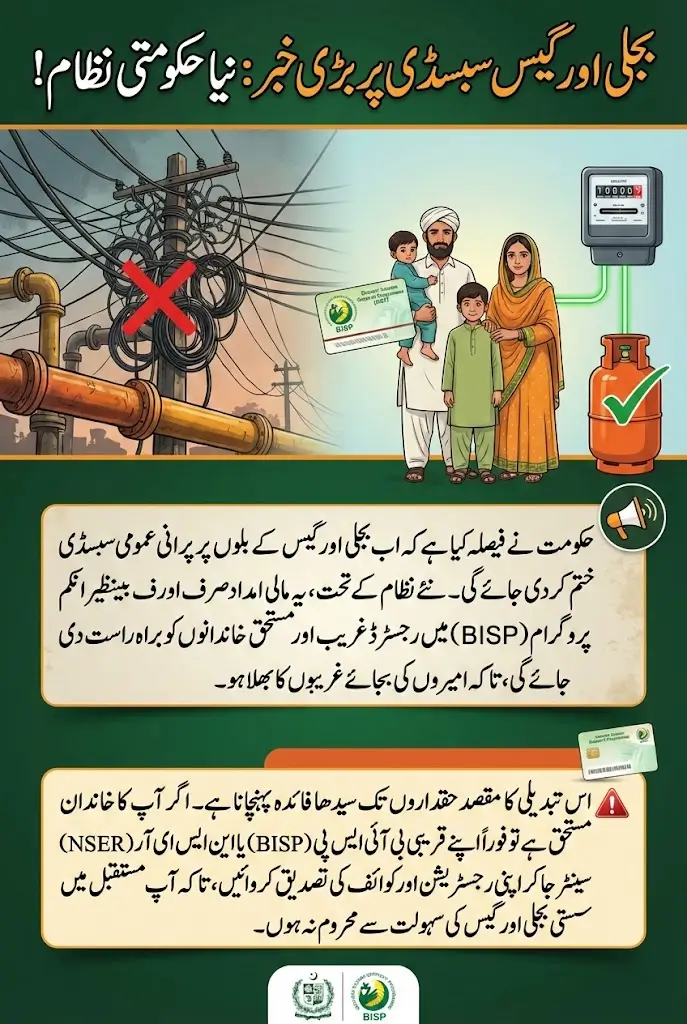
The announcement marks a major shift from blanket subsidies to a targeted mechanism. Instead of supporting all consumers, the new system will provide relief only to families registered under BISP, Pakistan’s flagship social protection programme. This move is expected to improve transparency, strengthen the social safety net, and align the subsidy system with international best practices.
Also Read: CM Punjab Expands Minority Card to 1 Lakh and New Registrations Are Now Open
Overview of the Government’s New Energy Policy 2026
The new subsidy model is being introduced to ensure efficient use of public funds. By connecting electricity and gas subsidies with BISP, the government aims to eliminate leakage and misuse. This targeted approach will help the poorest households manage rising living costs while reducing pressure on the national budget, especially in the power sector that has long suffered from circular debt accumulation.
The World Bank supports this restructuring, calling it a crucial step to improve governance in Pakistan’s energy system. The policy is also aligned with recommendations to reduce fossil fuel subsidies and redirect financial resources toward social protection programmes that support vulnerable households.
Main And Important Reasons Behind This Policy Shift
Pakistan’s power and gas sector has experienced long-term inefficiencies due to mismanaged subsidies and circular debt. Subsidies provided across all consumption levels created distortions, encouraged overuse, and pushed the sector toward financial instability. By targeting only BISP-verified poor families, the government aims to restructure subsidy spending in a more sustainable manner.
The World Bank has repeatedly emphasized that poorly targeted subsidies fail to support poverty reduction. Instead, they burden the economy and drain public finances. With the new system, subsidy allocation will depend entirely on verified poverty data, ensuring that relief reaches only deserving families.
- Circular debt in the power sector crossing sustainable limits
- Widespread misuse of subsidies by high-income consumers
- Pressure on national budget due to increasing fossil fuel dependency
- Need for data-driven governance in social protection
- Support from international institutions for targeted assistance
This shift reflects the government’s intention to make the national subsidy system more transparent and financially stable.
How BISP Will Become Central To Future Subsidy Distribution?
BISP has evolved into Pakistan’s most reliable social protection platform due to its strong digital systems and transparent processes. The programme uses proxy means testing and household surveys to identify poverty levels, ensuring that only deserving families qualify for assistance. By linking subsidies with BISP data, Pakistan aims to strengthen both energy policy and social welfare.
The World Bank considers BISP a model for South Asia because of its digital infrastructure, self-registration options, and rapid response during emergencies. This credibility is the main reason the government selected BISP as the central distribution point for future subsidies.
- A well-established national social registry
- Modern digital verification systems
- Accurate assessments using PMT scores
- Proven performance during the Covid-19 emergency cash distribution
- Ability to scale up support during crises
This integration will ensure that monetary assistance directly reaches low-income households without administrative losses.
New Subsidy Eligibility: What Families Must Know
Under the new policy, only families officially registered with the Benazir Income Support Programme will receive electricity and gas subsidies. This means households not listed in the BISP database will no longer qualify for government-funded relief. The World Bank report confirms that this reform aims to ensure fairness and eliminate subsidy misuse by wealthier households.
Families interested in receiving future subsidies must verify their PMT score and complete their registration at the nearest BISP or NSER center. Registration is free and requires only basic documents to confirm identity and household financial details.
- The family must be registered under BISP
- The PMT score must fall within the eligibility range
- The applicant must have valid CNIC data updated in the system
- The household should not be receiving multiple government benefits
- Information must match the national social registry database
These criteria ensure that subsidies reach genuine low-income families.
Impact Of This Policy On National Energy And Financial Stability
The energy sector in Pakistan has struggled due to excessive line losses, poor recovery rates, and heavily subsidized tariffs for different consumer classes. Circular debt accumulated as a result, placing additional burdens on the national budget. By targeting subsidies, the government expects to gradually decrease this debt and improve sector performance.
Additionally, removing inefficient subsidies allows the government to redirect funds toward long-term development, such as health, education, infrastructure, and climate resilience. This is expected to strengthen Pakistan’s overall economic stability and improve governance.
- Reduction in circular debt growth
- Improved financial health of electricity and gas companies
- Better budget allocation toward social safety nets
- Removal of distortions caused by generalized subsidies
- Stronger alignment with global economic standards
These improvements will support long-term stability and improved service delivery.
Comparison Of Blanket Subsidies And Targeted Subsidies
Blanket subsidies benefit all consumers regardless of income, which increases the financial burden on the economy. Targeted subsidies help the poorest families without wasting public funds. This comparison explains the value of the new approach.
| Feature | Blanket Subsidy Model | Targeted BISP-Linked Model |
|---|---|---|
| Coverage | All consumers | Only registered families |
| Financial Impact | High burden on budget | Reduced subsidy cost |
| Targeting Accuracy | Poor | High |
| Circular Debt Effect | Increases rapidly | Expected to decrease |
| Governance Efficiency | Low | Strong and data-driven |
This comparison highlights why the government adopted the new subsidy policy.
Also Read: Punjab Launches Phase 2 of CM Honorarium Card 2026: Masjid Imams to Get Rs. 25,000 Wazifa
Challenges That May Arise Under The New System
While the new policy is a major step forward, some challenges may appear during implementation. Not all families are currently registered with BISP, and some may face delays in verification. Additionally, the transition from a blanket subsidy model to a targeted one requires adjustments by consumers.
- Need for widespread BISP registration drives
- Possible delays in PMT score updates
- Requirement for modern data-sharing systems
- Consumer complaints during early transition
- Need for clarity among gas and electricity providers
These challenges must be addressed to ensure a smooth and effective subsidy transition. Administrative capacity must remain strong to ensure smooth integration between BISP databases and energy distribution companies. Any mismatch in consumer records may temporarily disrupt subsidy delivery.
Final Words
Pakistan’s decision to link subsidies with BISP is a powerful reform that aims to strengthen the country’s social protection and energy governance. The policy reflects a long-term strategy to improve targeting, reduce financial waste, and support only the families who truly require government assistance.
If implemented effectively, the new system will help Pakistan reduce circular debt, improve service delivery, and stabilize public finances. This policy marks an important step toward a more transparent and economically secure future.
Also Read: Punjab Grade 8 Exams 2026 May Be Cut to 4 Subjects Amid Severe PECTA Budget Crisis
FAQs
What is the main purpose of linking subsidies with BISP?
The purpose is to ensure that only low-income families receive government financial assistance and to eliminate subsidy misuse.
Will all electricity and gas consumers receive subsidies now?
No, subsidies will only be provided to households registered under BISP.
How can families become eligible for these subsidies?
They must complete registration at a BISP or NSER center and meet the PMT eligibility score.
Why are blanket subsidies being removed?
They were financially unsustainable and failed to support the poorest households.
Will this policy reduce circular debt?
Yes, targeted subsidies are expected to reduce pressure on the power sector and national budget.