

BISP Payment Block Tax Record 2025
BISP Payment Block Tax Record 2025: BISP has remained one of the most important welfare initiatives in Pakistan, providing financial relief to millions of poor households. In 2025, eligible families are entitled to receive Rs. 13,500 every three months to help manage essential expenses such as food, health care, education, and utilities. However, this year a new challenge has emerged. BISP payments are now directly linked with tax records, and thousands of beneficiaries have seen their payments blocked due to errors or outdated data.
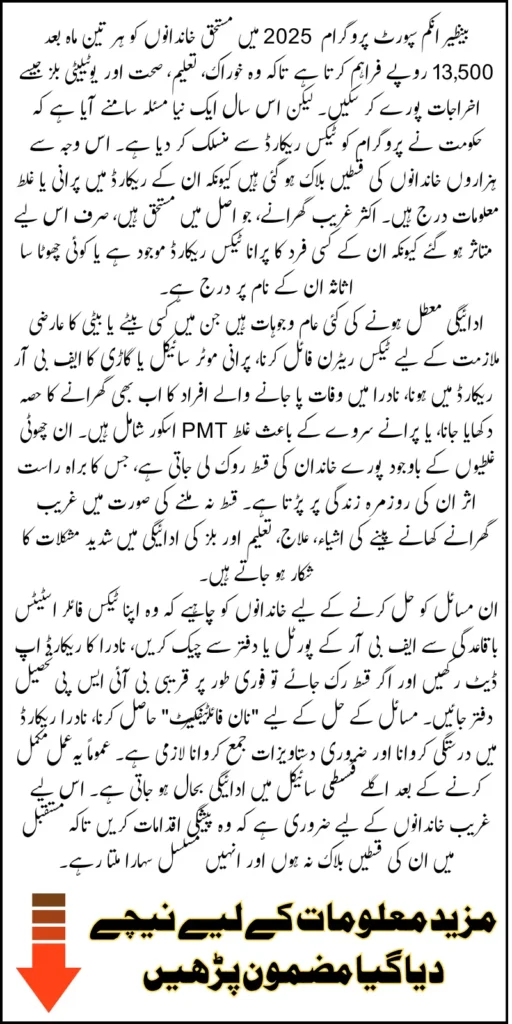
This article explains why BISP payments are being blocked in 2025, the role of tax records in eligibility checks, the main causes of suspension, and a complete step-by-step guide to help families fix these issues. If you are facing problems with your BISP installment, this detailed guide will help you understand and resolve them effectively.
Also Read: BISP 8171 Web Portal CNIC Check Online October 13500 Full Guide
Why Tax Records Are Causing BISP Payment Blocks
The government’s decision to connect tax records with BISP eligibility is based on the assumption that tax filers earn more than the poverty line and therefore do not require government aid. On paper, this approach seems fair. However, in reality, the system has created difficulties for many poor households.
In several cases, families living below the poverty line have been mistakenly flagged as tax filers. This can happen when a household member once filed a tax return for a low-income job, purchased a small vehicle, or had financial activity recorded in government systems. Despite their actual financial struggles, the system automatically categorizes them as ineligible for BISP.
Common Reasons Families Are Flagged as Tax Filers
Thousands of families have reported payment suspensions in 2025 due to minor or outdated entries in government records. These are some of the most common causes:
- A son or daughter filed a tax return for a temporary or low-paying job
- A small asset such as a motorbike or old car is still listed in FBR records
- Savings accounts or small financial transactions mistakenly appear as taxable income
- NADRA database shows outdated or deceased members as part of the household
- Old employment history wrongly recorded as taxable income
Such errors, while minor in nature, are enough to block the entire family’s BISP payment. Families who heavily depend on the Rs. 13,500 installment suddenly find themselves without support.
Also Read: Sindh Wheat Growers Support Programme 2025 Has Started Know Step-by-Step Online Registration
Impact of Payment Suspension on Families
The suspension of payments has a direct and serious impact on low-income families. For many households, the quarterly installment is the main financial support that helps them manage daily expenses. Losing this assistance creates immediate hardships.
Families use the installment to purchase food supplies, pay school fees, cover medical bills, and pay utility charges. Without it, they are often forced to borrow money, delay their children’s education, or compromise on health and nutrition. The impact is particularly severe on widows, disabled persons, and single-parent households who already face higher vulnerabilities.
Major Causes of BISP Payment Suspension
In 2025, most payment suspensions are linked to data errors in FBR, NADRA, or the BISP survey. Beneficiaries often believe they made no mistake, yet their payments are still blocked.
| Cause | Description |
|---|---|
| Household member listed as tax filer | Even one entry in FBR blocks the entire family’s payment |
| NADRA data errors | Outdated CNICs or wrong family members listed |
| Incorrect PMT score | Miscalculated poverty score due to old survey data |
| NSER not updated | Household not included in the latest survey |
Understanding these reasons allows families to take the right corrective steps and avoid unnecessary delays.
Also Read: 8171 Ehsaas Program Payments October 2025 Latest Update For Beneficiaries For New Installment 13500
How to Check Tax Filer Status in 2025
To avoid sudden payment suspension, families should regularly check if any household member is listed as a tax filer. The process has been made easier with multiple options available.
You can confirm your tax filer status through the following methods:
- Use the FBR Active Taxpayer List (ATL) portal for an online check
- Call the FBR helpline at 051-111-772-772 and verify by providing CNIC details
- Visit the nearest FBR office with your CNIC and income-related documents
- Ask a relative with internet access to check on your behalf if you live in a rural area
By checking regularly, families can identify errors early and begin the correction process before payments are stopped.
Step-by-Step Guide to Fix Tax Record Errors
If your BISP payments have been blocked due to tax record issues, you need to take action quickly. The process requires proper documentation but can be managed with the following steps:
- Apply for a Non-Filer Certificate from the nearest FBR office
- Update your NADRA records to remove deceased or migrated family members
- Correct household details such as CNIC expiry or spelling mistakes in records
- Visit the nearest BISP Tehsil Office with all supporting documents, including CNIC, proof of income, and non-filer certificates
- Use BISP mobile registration vans in rural areas for quick corrections
- After updating, send your CNIC to 8171 to confirm your status and recheck eligibility
Most families who follow this process correctly can restore their payments within the next cycle.
Tips to Protect BISP Eligibility
Preventive measures can help families avoid payment blocks in the future. Regular updates and proactive checks are the most reliable way to keep your eligibility safe.
Some useful tips include:
- Keep NADRA information updated every year
- Take part in every NSER survey conducted in your area
- Do not share CNIC copies with unknown agents
- Check your tax filer status regularly through the FBR portal
- Save all SMS confirmations from 8171 as proof of registration and payment history
By following these steps, households can avoid sudden disruptions and secure uninterrupted support from BISP.
What Families Should Do in 2025
The best approach for beneficiaries is to remain proactive. Waiting until payments are blocked only increases financial stress. Instead, families should regularly check both NADRA and FBR records, update details immediately, and maintain proper documentation.
Visiting the nearest BISP Tehsil Office remains the most effective method to resolve issues. Families are also encouraged to keep SMS confirmations safe and never ignore eligibility updates from the 8171 service.
Conclusion
The link between tax records and BISP payments in 2025 has created serious challenges for many poor households. While the government’s goal is to ensure only deserving families benefit from the scheme, errors in FBR and NADRA data have caused thousands of genuine beneficiaries to lose their payments.
By understanding the reasons for suspension, checking tax status, and following step-by-step solutions, families can restore their payments. The key lies in staying proactive, keeping records updated, and addressing errors as soon as they appear. BISP remains a lifeline for millions, and protecting eligibility is essential for continued support.
Also Read: BISP Phase 3 October 2025 Installment 13500 Payment Start And New Payment Methods Explained
FAQs
Why are BISP payments being blocked in 2025?
Because tax filer records are now linked to eligibility, and even minor errors can block payments.
Can one family member’s tax record block everyone’s payment?
Yes, if even one member is listed as a filer, the entire household’s installment is stopped.
How can I check if I am wrongly marked as a filer?
You can use the FBR ATL portal, call the helpline, or visit the FBR office with your CNIC.
What documents are needed to fix blocked payments?
You need a CNIC, non-filer certificate (if required), and any income-related proof for verification.
How long does it take to restore BISP payments after correction?
Usually within the next installment cycle, provided all documents are updated correctly.