
BISP 8171 Payment Delay 2026
BISP 8171 Payment Delay 2026: BISP 8171 payments for February and March 2026 are being delayed in many districts of Pakistan, even for women who are already registered and previously received installments on time. This delay has created confusion because some families are receiving the 8171 confirmation message, while others are seeing pending status or no record on the portal.
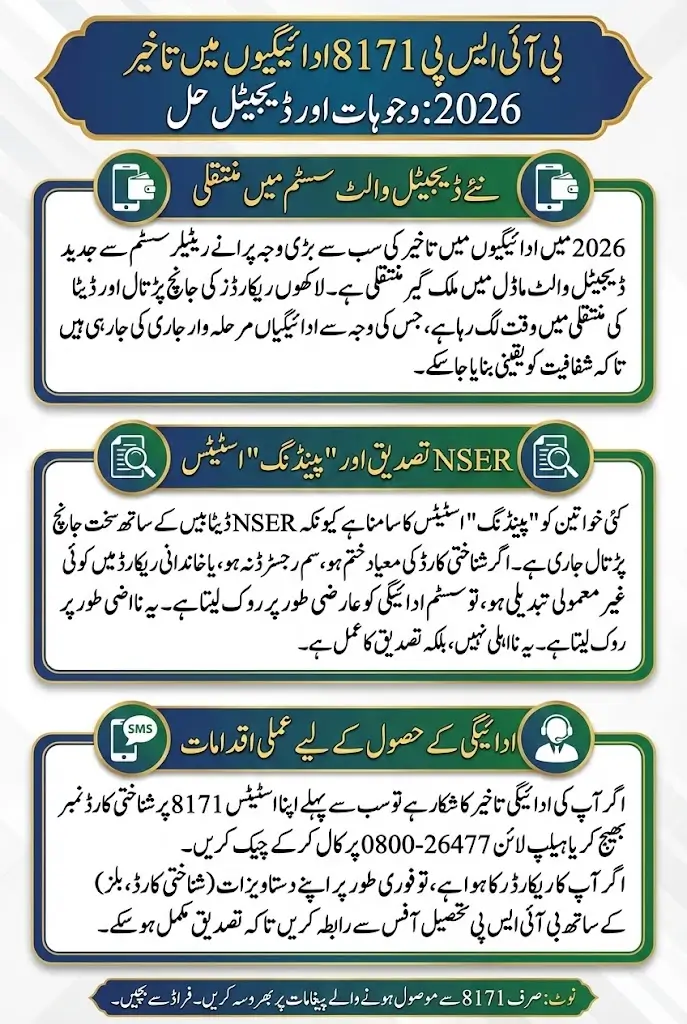
This complete guide explains the real reasons behind the BISP 8171 payment delay 2026, the new disbursement timeline, and the exact solutions you should follow to receive your Rs. 13,500 without stress. It also covers digital wallet transition, NSER verification holds, biometric issues, and step-by-step actions that can help you unlock your payment quickly.
Also Read: Punjab Schools Timetable For Ramadan 2026
Why BISP 8171 Payments Are Delayed in 2026 (Official Reason)
The biggest official reason behind BISP payment delays in 2026 is the nationwide shift toward a new payment system. BISP is gradually ending the old campsite and retailer-based cash system and moving beneficiaries to a modern digital wallet model. This transition is taking time because millions of records must be updated and verified before the amount can be transferred.
Many women think the delay means they have been removed from the program, but in most cases, this is not true. The delay is happening because the system is being upgraded and payments are being released phase by phase. This is a controlled process designed to stop illegal deductions, reduce crowds, and ensure the full Rs. 13,500 reaches the beneficiary.
Digital Wallet System 2026: How the New Payment Method Works
In 2026, BISP is introducing a digital wallet system where payments will be transferred directly into the beneficiary’s wallet or bank-linked account. This means women will not need to stand in long lines at payment centers again. The amount will be credited directly, and the beneficiary will be able to withdraw it from approved agents or banking partners.
This system is more secure and transparent, but the delay is happening because the government is migrating data from the old system to the new infrastructure. This process includes linking CNIC numbers with wallet accounts and confirming personal details, which is why payments are slower during February and March 2026.
- Payment will be credited directly to a digital wallet or bank-linked account
- Beneficiary CNIC must match the registered record
- SIM should be active and preferably registered on the beneficiary’s CNIC
- Full amount Rs. 13,500 will be received without agent deductions
- Payment release depends on district schedule and data migration speed
This digital wallet system is a long-term improvement, but in the early months of 2026, it is also creating temporary delays for many families.
Also Read: Punjab Class 10 Date Sheet 2026 Announced
Why Your Payment Shows Pending Even If Others Received It?
Many women complain that their neighbor received the BISP message, but their own CNIC status still shows pending or under verification. This happens because payments are not released for everyone at the same time, even in the same district. Each beneficiary record is checked separately through automated verification.
In early 2026, the BISP system is applying a dynamic cross-check process, which means your eligibility is being matched with multiple government databases. If any mismatch appears, the system places your payment on hold until verification is completed. This does not mean disqualification, but it does mean your payment will not be released until the issue is resolved.
Some common reasons your record may not update are listed below.
- CNIC expired or renewal pending
- SIM not registered in your name
- Family members changed in NADRA record
- Utility bills increased suddenly
- Vehicle or property mistakenly linked with your CNIC
- NSER survey record is outdated
These issues are fixable, but you must identify the exact reason through proper channels like SMS, helpline, or BISP office.
NSER Verification Hold 2026: The Main Reason Behind Payment Stuck
NSER (National Socio-Economic Registry) is the core database that decides whether a family qualifies for BISP payments or not. In 2026, NSER verification has become stricter because the government is trying to ensure only deserving families remain in the program. This is why many payments are stopped temporarily for verification.
If the system finds any unusual change in your profile, such as higher income signals or mismatched family record, it automatically blocks the payment for review. This is called a verification hold. In most cases, once you update your documents or complete re-survey, the payment becomes active again.
- NADRA family record and CNIC validity
- Electricity and gas bill usage trend
- Vehicle registration record through excise department
- Property or land ownership indicators
- Travel or passport-related activity in some cases
This verification process may take time, but once cleared, your payment status usually changes from pending to eligible.
Also Read: 8171 PMT Score for Ehsaas Program
New BISP 2026 Payment Schedule (Phase-Wise Disbursement Timeline)
In 2026, BISP has introduced a phase-wise payment release system to control crowds and prevent system overload. Instead of releasing payments in all districts at once, BISP is distributing funds in multiple phases. This is why some districts receive payments in early February, while others wait until March.
This new schedule is also linked to digital wallet activation. Districts where wallet integration is completed earlier receive payments sooner. If your district is still under migration or verification, your payment will appear late even if you are eligible.
- Phase 1: Late February 2026 (high population and high poverty districts)
- Phase 2: March 2026 (medium-load districts and central areas)
- Phase 3: March 2026 (remaining districts, northern areas, GB, remote zones)
If your district falls in Phase 2 or Phase 3, the portal may show no update until your official release date arrives. That is why checking timeline information is important before visiting any payment center.
How to Check BISP 8171 Payment Status in 2026 (Correct Methods)
To avoid misinformation and agent fraud, BISP has provided official channels for checking payment status. Every beneficiary should use these channels before taking any action. Many people waste time visiting offices without checking status properly, which creates unnecessary pressure and confusion.
In 2026, payment checking is easier than before, but beneficiaries must follow the correct method. If you use unofficial websites or random WhatsApp groups, you may be misled or even scammed.
Use these official verification methods.
- Send CNIC (13 digits) to 8171 through SMS
- Call BISP helpline at 0800-26477 for account status
- Visit BISP Tehsil office grievance desk for detailed record check
- Check BISP updates through mobile registration vans in rural areas
- Confirm payment status only through official BISP portal if available
After checking through these methods, you will clearly understand whether your payment is delayed due to schedule or blocked due to verification issues.
BISP Helpline and Mobile Vans: Best Support for Rural Women
BISP has expanded its support services in 2026, especially for rural women who cannot travel frequently. The helpline is one of the easiest ways to confirm whether your CNIC is blocked, eligible, or under verification. If your payment is delayed for more than two weeks after your phase begins, calling the helpline is strongly recommended.
Mobile registration vans are also playing an important role in remote areas. These vans have biometric devices and internet connectivity, allowing staff to update NSER details on the spot. Women can correct basic data errors, confirm their eligibility, and sometimes resolve pending cases without visiting the tehsil office.
- Helpline 080026477 is active during working hours (9 AM to 5 PM)
- Keep CNIC number ready before calling
- Ask clearly if your record is blocked, pending, or eligible
- For vans, check Union Council announcements or local BISP notice
- Carry CNIC and children B-Forms when visiting a van
These support channels reduce travel costs and help women fix issues quickly.
Also Read: How To Verify Payment 13000 Of 9999 Ramzan Package By Shahbaz Sharif Know In Details
Step-by-Step Solution If Your BISP Payment Is Delayed
If your payment is delayed in 2026, you should not wait silently for months. Most delays are resolved quickly when the beneficiary takes the correct steps. The first thing is to confirm whether your district phase has started or not. If your district is still waiting for release, the delay is normal.
However, if your district has started receiving payments and your record is still pending, then you must take action. Many cases are stuck due to expired CNIC, survey mismatch, or biometric issues. The sooner you update your record, the faster your payment will be unlocked.
- Wait 7 to 10 days after your district phase officially begins
- Send CNIC to 8171 to check if verification is in progress
- Call the helpline if status remains unchanged for 2 weeks
- Prepare documents for correction (CNIC, bills, B-Forms)
- Visit the BISP Tehsil Office grievance desk for final solution
- If required, complete a fresh NSER survey interview
Once the verification is completed, your pending amount is usually released in the next payment cycle or within the same phase, depending on the system update speed.
Required Documents to Fix BISP 8171 Payment Delay (2026 Checklist)
In 2026, BISP is demanding stronger documentation for corrections. Many women visit the office without proper documents and return without results. To avoid this, you should prepare a complete folder before going to any BISP center.
The most important document is your original CNIC. Without it, no verification can be completed. Along with CNIC, you must carry supporting proof such as bills and children’s documents because NSER scoring depends heavily on household size and expenses.
Carry these documents before visiting any office or mobile van.
- Original CNIC (must be valid and not expired)
- Registered SIM number (preferably on your CNIC)
- Latest electricity bill
- Latest gas bill (if applicable)
- Children’s B-Forms (for Taleemi Wazaif and family size proof)
- Husband CNIC copy (if required for record correction)
- Family Registration Certificate (if major family changes happened)
Having complete documents ensures your complaint is processed on the same day instead of being delayed again.
Also Read: 8171 Check Online CNIC Login
Common Issues and Required Solutions (2026)
Many beneficiaries face similar issues, and BISP offices usually resolve them through a standard process. The table below explains the most common problems and what you should do to solve them. This table can help you understand your case before visiting the office.
BISP Payment Issue Resolution
| Issue in Record | Why It Happens | Required Document | Solution |
|---|---|---|---|
| CNIC expired | NADRA renewal not done | New CNIC | Renew CNIC and update at BISP office |
| SIM not matched | SIM not registered in beneficiary name | SIM ownership proof | Update mobile number at BISP center |
| Payment pending | Verification hold due to NSER sync | CNIC + bills | Wait phase start, then visit grievance desk |
| Family data mismatch | NADRA family record updated | B-Forms + FRC | Update family record and resurvey if required |
| High PMT score | bills increased or data changed | Latest utility bills | Submit proof and request review |
| Biometric failure | Fingerprint mismatch | CNIC + NADRA verification | Request face verification support |
This table covers the most common cases and helps you avoid confusion when your payment status is not updating.
Ghost Vehicle or Property Issue in 2026 (Major Cause of Blocking)
One of the most serious reasons behind BISP 8171 payment delay in 2026 is the ghost asset issue. This happens when a vehicle or property is wrongly registered under your CNIC. Sometimes this is due to fraud, outdated records, or a clerical mistake in excise or property registration systems.
When the NSER system detects any vehicle registration, it automatically considers the household financially stronger. Even if you do not own the vehicle, your payment may be blocked until you prove that the asset is not yours. Many women remain stuck for months simply because they do not know this issue exists.
To solve ghost asset problems, follow these steps.
- Visit the Excise Department office in your district
- Request verification of vehicle registration under your CNIC
- Apply for a Non-Ownership Certificate if vehicle is not yours
- Submit the certificate at BISP Tehsil office grievance desk
- Request re-check of eligibility after asset removal confirmation
This solution is necessary because without clearing the asset record, the system will continue holding your payment.
Taleemi Wazaif Delay With Kafalat Payment (Important Update)
Many families receive BISP Kafalat payment along with Taleemi Wazaif, which is the education stipend for children. If your Rs. 13,500 payment is delayed, the Taleemi Wazaif amount is also usually delayed. This is because both payments are connected to your main eligibility profile.
In 2026, Taleemi Wazaif requirements are stricter. School attendance is now more closely monitored, and if the child does not meet the required attendance level, the stipend may be paused. Many mothers receive Kafalat money but do not receive children’s stipend because school record verification is incomplete.
- Ensure your child is enrolled in a registered school
- Maintain minimum attendance requirement
- Keep school record updated in BISP system
- If stipend is missing, request verification slip from school
- Submit the slip to BISP office for Taleemi Wazaif activation
This ensures your children’s education support continues without interruption.
Fraud Alerts and Safety Tips for BISP Beneficiaries in 2026
Due to payment delays and the digital wallet system, fraud cases have increased in 2026. Many scammers are calling women and pretending to be BISP staff. They ask for OTP codes, wallet PINs, or demand money to unblock payments. This is illegal and must be avoided.
BISP never asks for payment clearance fees. Also, no official will request your wallet password. The only trusted SMS number is 8171. Any other number sending payment messages is suspicious and should be ignored.
- Trust only 8171 for SMS updates
- Never share your wallet PIN or OTP with anyone
- Never pay any agent for “payment release”
- Report deductions or fraud to BISP helpline immediately
- Always withdraw payment from approved partners only
These safety steps protect your Rs. 13,500 and ensure you do not become a victim of fraud.
Final Words for BISP 8171 Beneficiaries (2026 Guidance)
BISP 8171 payment delay in 2026 is a real issue, but in most cases it is temporary and solvable. The main reasons include digital wallet transition, NSER verification holds, phase-wise payment schedule, and documentation mismatches. Once the system completes verification and data migration, payments will become faster and more transparent.
If your payment is delayed, the best approach is to stay calm, verify status through 8171, and take action if your district phase has already started. Keeping your CNIC valid, SIM registered, and NSER data updated is the strongest way to secure your Rs. 13,500 without repeated delays.
FAQs
Why is my BISP 8171 payment delayed in 2026?
Your payment may be delayed due to digital wallet migration, NSER verification, or phase-wise release schedule.
How can I check my Rs. 13,500 payment status?
Send your CNIC to 8171 or call the BISP helpline 0800-26477 for official confirmation.
What does “verification in progress” mean in 8171 SMS?
It means your record is being checked through NSER and other databases, and payment will release after approval.
Can I receive payment if my CNIC is expired?
No, you must renew your CNIC from NADRA and then update the record at BISP office.
Will Taleemi Wazaif also be delayed if Kafalat is pending?
Yes, in most cases Taleemi Wazaif is linked to the main payment, so delays affect both installments.